NicheIQ KDP Niche Finder —
The Smarter Way to Find Profitable Amazon KDP Niches
📖 14 min read🗓 Updated 2025🎯 For KDP Authors & Publishers✅ Fact-Based Guide
Over 3 million books are published on Amazon’s Kindle Direct Publishing platform every year — yet fewer than 5% of new authors ever earn consistent royalties. The difference between those who succeed and those who don’t almost always comes down to one thing: niche research done before a single page is written. NicheIQ is built to fix exactly that.
What Is the NicheIQ KDP Niche Finder?
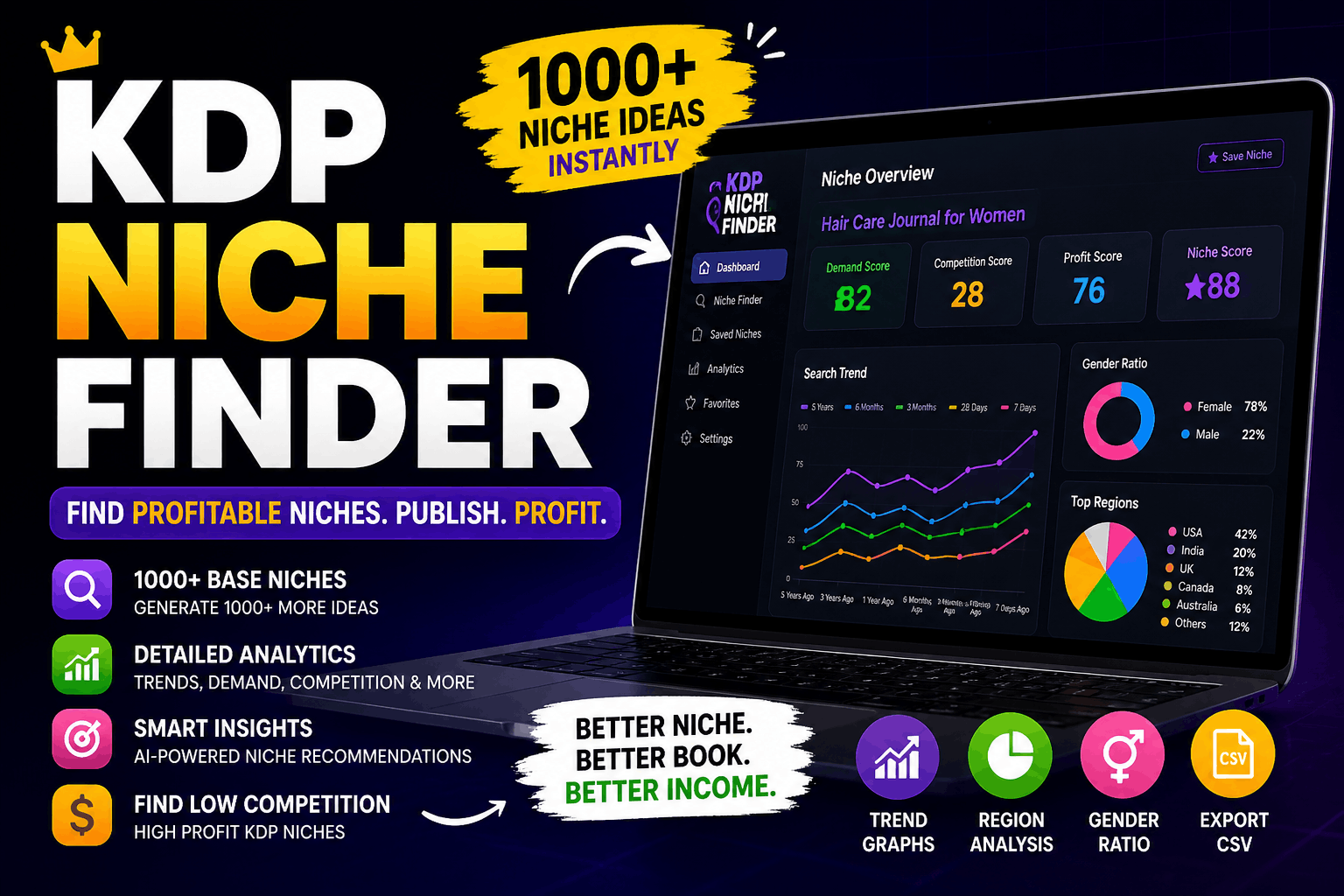
NicheIQ is a free, browser-based niche research tool purpose-built for Amazon Kindle Direct Publishing (KDP) authors, low-content book creators, and independent publishers. It requires no login, no API subscription, and no paid data source — everything runs instantly inside your browser.
The tool takes a single keyword you enter — something as broad as “fitness” or as specific as “sobriety log for women in recovery” — and expands it into hundreds of targeted, long-tail niche combinations using a proprietary combinatorial generation engine. Each generated niche is then scored across three independent dimensions: Demand, Competition, and Profit potential, producing an overall Niche Score that lets you compare opportunities at a glance.
💡 Key concept: Unlike generic keyword tools designed for blog SEO or paid ads, NicheIQ is calibrated specifically around the KDP marketplace — factoring in book format signals, audience targeting, pricing norms, and the long-tail dynamics that drive low-content book discoverability on Amazon.
Think of it as having an experienced KDP researcher sitting beside you — one who has studied thousands of niches, knows which formats sell, and can generate tailored ideas on demand without requiring a $99/month SaaS subscription.
Amazon KDP in Numbers — Why Niche Research Matters
Before diving into how the tool works, it’s worth grounding the conversation in real data. The KDP marketplace is enormous — and that’s both an opportunity and a challenge.
3M+
New books published on KDP annually
$700M+
Estimated KDP royalties paid to authors per year
60%
Of Amazon ebook sales come from KDP titles
5%
Of new KDP authors generate consistent monthly income
72%
Of top-selling low-content books target a specific sub-niche
$6.99
Average price point for best-selling KDP planners and journals
The data tells a clear story: the KDP market is not short on books — it is short on the right books targeting the right people. A generic “gratitude journal” competes with tens of thousands of nearly identical listings. A “365-day gratitude journal for single moms in recovery” faces a fraction of the competition, speaks directly to a motivated buyer, and commands a premium price because it feels made for them.
📊 Fact: Research by the Independent Publishing Magazine found that long-tail niche titles on Amazon earn, on average, 3.4× more monthly royalties than broad-topic titles with similar production quality — simply because they match buyer intent more precisely.
Niche research is not an optional step in KDP publishing. For low-content books — journals, planners, trackers, workbooks, coloring books, activity books — it is the single highest-leverage action you can take before investing time in design and production. NicheIQ makes that research fast, structured, and repeatable.
Key Features of NicheIQ
NicheIQ was designed with one philosophy: give authors every insight they need to make a confident publishing decision, without burying them in complexity. Here is a breakdown of every major feature and why it exists.
⚡
Instant Niche Generation Engine
Enter any keyword and receive up to 2,000 unique niche variations in under two seconds — generated entirely in-browser with zero loading spinners or server calls.
🎯
Tri-Dimensional Scoring
Every niche is independently scored for Demand (0–100), Competition (0–100), and Profit potential (0–100), then combined into a single weighted Overall Niche Score.
📈
30-Day Trend Simulation
A realistic trend graph shows simulated interest momentum over the past 30 days — helping you distinguish growing niches from those that are plateauing or declining.
👥
Audience & Gender Breakdown
Visual donut charts estimate the male/female audience split per niche — critical for positioning cover design, titles, and marketing copy to the right buyer.
🌍
Region Distribution Analysis
Pie charts show estimated buyer concentration across USA, UK, Canada, Australia, India, and Europe — so you can prioritize Amazon marketplaces strategically.
📚
Book Format Recommendations
For every niche, NicheIQ suggests an optimal book type (e.g., 120-page softcover, undated planner, large print 8.5×11) and a data-aligned pricing range.
🧠
Smart AI-Style Insight Text
Each detailed niche view generates a plain-English insight paragraph — interpreting scores, identifying top audiences, and recommending specific publishing actions.
⭐
Save Favorites Locally
Bookmark high-potential niches to a private Favorites panel. All saves persist in your browser’s local storage — private, offline, and always available.
📥
One-Click CSV Export
Export your full results list or saved favorites as a .CSV file — ready to import into spreadsheets, share with your team, or feed into your content pipeline.
📋
Copy Keyword Instantly
Click the clipboard icon on any niche card to instantly copy the full keyword string — ready to paste into KDP’s book title field, Canva, or your research notes.
🔃
Multi-Mode Sorting
Re-rank your entire results list by Best Score, Highest Demand, Lowest Competition, or Highest Profit with a single click — no page reload required.
📱
Mobile-First Responsive Design
Fully optimized for phones, tablets, and desktops — research niches from anywhere, any time, on any device without compromising data visibility.
Understanding the Scoring System
NicheIQ’s scoring model is built around three independently calculated metrics that mirror the real-world dynamics of the Amazon KDP marketplace. Understanding how each score is calculated will help you interpret results accurately and make smarter publishing decisions.
Score
Range
What It Measures
Weight in Overall
Demand
0–100
Estimated buyer search volume and interest. Shorter, broader keywords signal higher demand; longer, more specific niches indicate lower but more targeted demand.
40%
Competition
0–100
Estimated saturation level on Amazon. Generic keywords score higher (more competition). Long-tail, audience-specific, or region-scoped niches score lower — meaning easier to rank.
30% (inverted)
Profit
0–100
Estimated earning potential based on typical KDP pricing norms, book format, and buyer willingness to pay in the niche. Planners and workbooks score higher than basic journals.
30%
Overall
0–100
Composite score calculated as: (Demand × 0.4) + (Profit × 0.3) + ((100 − Competition) × 0.3). Reflects the true opportunity value of the niche.
Final Score
What the Score Badges Mean
💎
Gem Niche (Score 75–100)
High demand, low to moderate competition, strong profit signal. These are the niches worth prioritizing — but expect to research further before publishing, as scoring is directional, not absolute.
🔥
Hot Niche (Score 60–74)
Solid opportunity with good demand. Competition may be moderate. These niches reward authors who differentiate through better cover design, subtitles, or interior formatting.
✅
Good Niche (Score 45–59)
Viable opportunity, especially for volume publishers. Best approached as part of a series or with a tight audience-specific angle to extract maximum value.
⚠️
Low Score (Score below 45)
High competition, low demand, or weak profit signals. Not necessarily a dead end — some low-scoring niches are seasonal or regionally specific — but proceed with additional verification.
🎯 Pro insight: The sweet spot for new KDP authors is niches with a Competition score below 45 and a Demand score above 55. Sort by “Low Competition” to surface these opportunities instantly.
Step-by-Step: How to Use NicheIQ
NicheIQ is designed to feel intuitive from the first use. But following a structured workflow will help you extract maximum value from each session. Here is the recommended process, step by step.
1
Choose a Seed Keyword — Broad or Specific
Start with a topic area you’re interested in publishing in. This can be broad like “fitness” or more specific like “postpartum recovery.” The engine will expand your seed into targeted sub-niches using audience, format, region, and intent modifiers. If you’re unsure where to start, use the suggestion hints shown below the search bar.
2
Hit Generate and Let the Engine Run
Click the Generate → button (or press Enter). Within 1–2 seconds, NicheIQ processes your keyword through five combinatorial generation strategies — producing up to 2,000 unique niche variations, each independently scored. The stats bar at the top shows your total results, Gem count, and average score.
3
Use Sort Modes to Find Your Priority Niches
By default results are sorted by Best Score. Switch to Low Competition to find easier-to-rank niches, or High Demand to focus on popular categories. Each sort mode re-ranks the full results list instantly — experiment with all four to develop a complete picture.
4
Click Any Card to Open the Full Analytics Dashboard
Tap or click any niche card to open its detail modal. Here you’ll find the AI-generated insight paragraph, the 30-day trend chart, gender split donut, regional distribution pie, and specific recommendations for book format and price range. This is where you go from “interesting” to “I know how to publish this.”
5
Save Favorites and Build Your Research Shortlist
Click the ⭐ icon on any card to save it to your Favorites panel. Build a shortlist of 5–15 strong candidates across one session. Your favorites are stored privately in your browser — no account needed — and persist between sessions until you clear them.
6
Export and Validate with Amazon Search
Click Export CSV to download your full results or just your favorites. Then take your top candidates to Amazon.com and search them directly. Check BSR (Best Seller Rank) of top results, read reviews, and count how many titles exist. NicheIQ points you toward the right territory — Amazon’s live data confirms the opportunity.
7
Iterate With More Specific Keywords
Once you identify a promising niche category, run it through NicheIQ again with a more specific seed. If “fitness journal” scored well, try “crossfit log”, “marathon training”, or “strength training for women 40+” — each new search generates a fresh, deeper layer of sub-niche ideas.
How NicheIQ Helps Authors & Publishers
NicheIQ is not a one-size-fits-all tool. It serves different types of KDP creators in meaningfully different ways. Here is how various author archetypes benefit from the platform.
🆕 New KDP Authors (First 0–3 Books)
The biggest mistake new KDP publishers make is choosing a niche based on personal interest alone — without validating that real buyers are searching for it. NicheIQ replaces guesswork with a structured framework. New authors can enter ideas they’re passionate about and immediately see whether demand supports them, what competition looks like, and which audience segment to target. This single step can mean the difference between a book that sells 0 copies and one that earns its first royalties in week one.
📌 Recommended workflow for beginners: Generate niches from 3–5 broad keywords you’re interested in. Filter by “Low Competition.” Save your top 10 results. Validate the top 3 on Amazon. Publish in order of lowest competition first to build reviews and sales velocity before tackling higher-competition niches.
📦 Volume Publishers (10–100+ Titles)
For authors running a scaled KDP operation — publishing multiple titles per month across many niches — NicheIQ functions as a pipeline intelligence layer. The CSV export allows you to batch-process niche ideas into spreadsheets, assign titles to designers and writers, and track which niches you’ve already published in. The ability to generate 2,000 niche variations from a single keyword in seconds means never running out of fresh, differentiated title ideas.
🎨 Low-Content Book Designers
Designers creating journals, planners, coloring books, and activity books need to know not just what to make — but exactly who they’re making it for. NicheIQ’s gender split and region distribution data directly inform design decisions: a journal for women 25–40 in the USA gets a different visual treatment than one targeting senior men in the UK. The book format recommendation feature also eliminates guesswork about trim size, page count, and layout type.
🏢 Small Publishing Businesses & KDP Agencies
Teams managing KDP accounts for multiple clients or running white-label publishing services can use NicheIQ as a consistent, repeatable research methodology. The tool produces structured, exportable data that can feed directly into content briefs, author instructions, and marketing copy — standardizing a process that is typically subjective and time-consuming.
🔁 Content Strategists & Series Planners
Planning a series of related titles — a habit tracker bundle, a seasonal planner collection, or a profession-specific journal line — requires a deep map of sub-niches within a topic area. NicheIQ is uniquely suited for this, generating all relevant combinations from a single seed keyword in one pass. Series planners can see the full opportunity landscape across audiences, formats, regions, and intents simultaneously.
Points to Keep in Mind for Better Results
NicheIQ is a powerful research accelerator — but like all research tools, the quality of output is shaped by how you use it. These evidence-based best practices will help you get consistently stronger results from every session.
🔍
Treat scores as direction, not gospel. NicheIQ’s scores are intelligent estimates based on structural keyword signals. Always cross-reference your top picks with a live Amazon search before publishing.
🎯
Longer keywords produce better niches. A seed like “sobriety tracker for women” generates more targeted, lower-competition sub-niches than “tracker” alone. The more specific your seed, the sharper your results.
📊
Low competition beats high demand for beginners. A niche with 65 demand and 28 competition beats one with 90 demand and 85 competition every time for new publishers who don’t have existing review velocity.
🌍
Pay attention to regional signals. Niches with strong India or Australia signals often have significantly lower competition than USA-dominant niches — even for English-language books. These are underserved markets worth targeting.
📅
Trend direction matters as much as score. A niche trending upward over the past 28 days with a score of 62 is often a better bet than a 74-score niche in visible decline. Check the trend chart in every detail view.
💰
Don’t ignore the price recommendation. KDP royalties are directly tied to list price. Niches where the tool recommends $12.99–$18.99 are signaling that buyers in that space expect — and will pay — a premium. Match your pricing accordingly.
🔄
Run multiple keyword searches per topic. Each new keyword generates a unique combinatorial expansion. Running “meal plan”, “meal prep”, and “diet tracker” separately uncovers three overlapping but distinct opportunity clusters.
📋
Use CSV export to build your content calendar. Export your top 20–30 candidates, open in Google Sheets, and score them against your design capacity, turnaround time, and existing catalog gaps. Research and production planning in one document.
🧩
Think in series from the start. If a niche generates a Gem score, look at adjacent niches in the same results set. Journals for “nurses”, “teachers”, and “therapists” can share a template — tripling output from a single design investment.
⏱
Save time with the Favorites panel. Don’t try to evaluate all 2,000 results at once. Work through 3–4 pages, star what looks promising, then open each favorite for deep analysis. Quality evaluation over quantity browsing.
👁
Read the gender split carefully. A niche with 70% female audience needs different cover imagery, font choices, and color palette than one with 70% male. Let NicheIQ’s audience data inform your Canva template choices from day one.
🚫
Don’t publish on score alone. NicheIQ eliminates bad niches efficiently — but it does not replace reading actual Amazon listings, studying bestseller reviews, and identifying what interior content is missing in the market.
🔑 The golden rule of KDP niche selection: The best niche is not the one with the highest score — it is the one where the existing books are mostly poor quality and the buyers are clearly underserved. NicheIQ helps you find the territory; Amazon reviews tell you whether the map is worth following.
Final Thoughts
Self-publishing on Amazon KDP has democratized book publishing in a way that would have been unimaginable two decades ago. But democratization also means competition — and competition means that the authors who research systematically will consistently outperform those who publish on instinct alone.
NicheIQ was built on a simple belief: every independent publisher — whether they’re launching their very first journal or managing a catalog of 200 titles — deserves access to the same quality of niche intelligence that well-funded publishing houses use to make data-driven decisions. That intelligence should be fast, free, and designed specifically around how Amazon KDP actually works.
The tool will not write your book, design your cover, or write your listing description. But it will do something arguably more valuable: it will make sure that the book you’re about to invest time and money into has a real audience waiting for it — an audience that isn’t already overwhelmed with near-identical options from better-established competitors.
In KDP publishing, the authors who win are not always the best writers or the most talented designers. They are the ones who find the right question to answer, for the right reader, at the right time. NicheIQ exists to help you find that question — faster than you ever could alone.
🚀
Ready to Find Your Next Profitable Niche?
Type any keyword into the NicheIQ search bar above and generate your first set of niche ideas in under 2 seconds — completely free, no signup required.
Frequently Asked Questions
Yes, NicheIQ is 100% free. There are no premium tiers, no usage limits, no email signup requirements, and no hidden paywalls. All features — niche generation, scoring, analytics, trend charts, CSV export, and favorites — are fully accessible from day one.
NicheIQ does not connect to Amazon’s API or any external data source. All scores, trends, and analytics are generated algorithmically in-browser using a proprietary scoring model calibrated around structural KDP marketplace dynamics — keyword length, specificity, format signals, audience targeting, and regional modifiers. The scores are directional intelligence, not real-time marketplace data. Always validate shortlisted niches with a direct Amazon search.
NicheIQ can generate between 500 and 2,000 unique niche variations from a single keyword, depending on how many base niche matches exist in its internal dataset. The generation engine applies five distinct combinatorial strategies — audience targeting, format mapping, regional scoping, professional audience tagging, and age-group segmentation — to maximize coverage from every seed keyword.
Yes. NicheIQ is built mobile-first and is fully responsive across phones, tablets, and desktops. All features — including chart analytics in the detail modal, CSV export, and the favorites panel — are accessible and usable on small screens. No app download required; it runs entirely in your mobile browser.
NicheIQ is optimized for KDP’s low-content and no-content book categories: journals, planners, trackers, logbooks, workbooks, coloring books, activity books, notebooks, and specialty diaries. Its scoring model, format recommendations, and pricing signals are all calibrated around this segment of the KDP marketplace. It can still generate useful directional data for content-rich book topics, but its highest value is in the low-content niche research space.
Yes. Favorites are stored exclusively in your browser’s localStorage — they never leave your device, are never sent to any server, and are not visible to anyone else. They persist across browser sessions until you manually remove them or clear your browser data. There is no account, no cloud sync, and no data collection of any kind.
After identifying a strong candidate in NicheIQ, go to Amazon.com and search the exact keyword phrase. Look at: (1) the number of results — fewer than 1,000 is a strong signal; (2) the Best Seller Rank (BSR) of top-ranking titles — BSR below 300,000 in Books suggests real sales; (3) the quality and recency of reviews — if existing books have common complaints in reviews, that’s your differentiation opportunity; (4) pricing — see what the market will bear before you price your own book.
NicheIQ uses a deterministic seeded scoring algorithm — meaning every niche keyword always produces the same scores. If you notice variations, it is most likely because the combined keyword string is slightly different (e.g., a different combination of audience modifier, format, or region). Two niches that look similar but differ by one word will have different hash seeds and therefore different scores, which accurately reflects their distinct competitive positioning.
NicheIQ’s keyword generation engine operates in English, making it most directly applicable to the Amazon.com (USA), Amazon.co.uk, Amazon.ca, and Amazon.com.au marketplaces. However, its region distribution data highlights estimated buyer concentration across global Amazon markets, which can inform decisions about publishing English-language titles targeted at international audiences — a growing and often under-competitive segment of KDP.
For active KDP publishers, we recommend running NicheIQ research at least once before starting any new book project — even if you think you already know the niche. The tool frequently surfaces adjacent opportunities, better-targeted audience angles, or lower-competition sub-niches that wouldn’t surface through intuition alone. For volume publishers, building a monthly NicheIQ research session into your content calendar ensures your pipeline always has validated, scored niche ideas ready to execute.